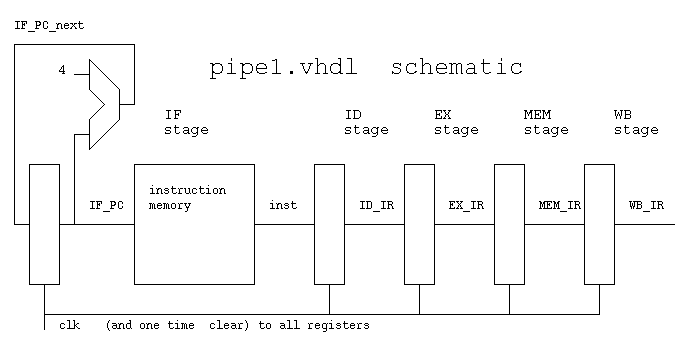
[CMSC 411 Home] | [Syllabus] | [Project] | [VHDL resource] | [Homework 1-6] | [Homework 7-12] [Files] |
The goal of the semester project is to design and simulate a pipelined RISC CPU. Major components will be the pipelined ALU data path, the instruction decoder, hazard detection and associated forwarding/stall and cache memory controller.
 The project is to be submitted on GL as five transactions for five files:
   submit cs411 part1 part1.vhdl
   submit cs411 part2 part2a.vhdl
   submit cs411 part2 part2b.vhdl
   submit cs411 part3 part3a.vhdl
   submit cs411 part3 part3b.vhdl

 The files you submit are not the starter files but the starter files
 with your additions to make it work.
 Starter files may be copied to  cadence1.cs.umbc.edu  using commands like:
 cp  /home/faculty4/squire/www/download/part1_start.vhdl .
 cp  /home/faculty4/squire/www/download/bshift.vhdl .
 cp  /home/faculty4/squire/www/download/part1.abs .
 cp  /home/faculty4/squire/www/download/part1.run .
 cp  /home/faculty4/squire/www/download/part1.chk .

 PART1: Handle lw, sw, add, sub, addi, sll, srl, cmpl and nop with no hazards.
        (nop's are inserted in the part1.abs file to prevent hazards.)
        See cs411_opcodes.txt for detailed instruction formats and definitions.
        See reglist.txt for register use conventions.
        You should use part1_start.vhdl as a start for coding your circuit.
        You can do your own shift circuit or use the bshift.vhdl component.

   Quick start steps:
     1)  copy part1_start.vhdl to part1.vhdl then work on project in part1.vhdl
     2)  replace all "part1_start" with "part1"
     3)  fill in VHDL for the ALU_32 architecture to implement
         sub, sll, srl, cmpl.  All other instructions must do a plain add.
         Note that EX_IR coming into ALU_32 has the opcode information
         and a possible schematic is alu.jpg
     4)  compute the signals   RegDst <=
                               ALUSrc <=
                               MEMWrite <=
                               WB_write_enb <= needs 'or' of more opcodes
          using   MEMRead <= (MEM_IR(31 downto 26)="100011");
          as an example for setting a mux control based on opcode.
          In each stage **_IR is the instruction currently in that stage.
          **_IR(31 downto 26) is the six bit major op code. "100011" for lw
          **_IR(5 downto 0) is the six bit minor op code. "100000" for add
          "=" in VHDL is "==" in C, "<=" or ":=" in vhdl is "=" in C.

     5) Get these files into your working directory: part1.abs and part1.run
     6) Compile, analyze, run using the commands

        ncvhdl -v93 add32.vhdl
        ncvhdl -v93 bshift.vhdl
        ncvhdl -v93 part1.vhdl  # renamed and modified part1_start.vhdl
        ncelab -v93 part1:schematic
	ncsim  -batch -logfile part1.out -input part1.run part1

        diff part1.out part1.chk        should be no differences
                                        no stalls, timing should be exact

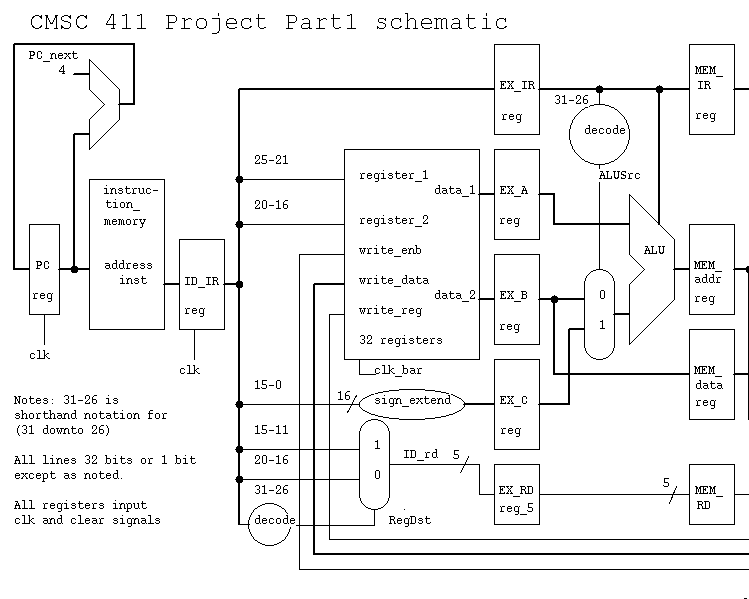
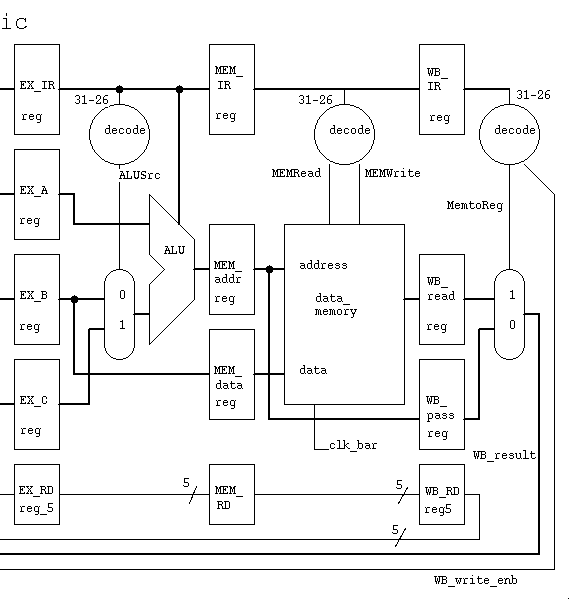
        The CS411 Project Part 1 uses a modified book Figure 6.12
        as shown in part1a.gif and part1b.gif

        For grading reasons, keep the signal names that
        are pipeline registers and the entity/memory names.


        The resulting output should be as shown in
         part1.chk  file based on part1.abs and  part1.run .

        Check the results in part1.out to be sure the instructions
        worked. You can follow each instruction through the pipeline
        by following the instruction register, *_IR and check the
        *_*  signals for correct values at each stage.

        It is possible that your part1.out does not agree with
        part1.chk but you should
        be able to explain why. (Probably different don't care choices.)

        You may want to copy part1.vhdl to another file and add more
        'write' statements to print out more internal signal names in order
        to help debug your circuit. debug.txt

        Submit all components and your main circuit as one plain text
        file using submit. No makefiles or run files or output is to be
        submitted. Partial credit will be given based on number of
        instructions simulated correctly. The starter file part1_start.vhdl
        only simulates the  lw  instruction correctly.

 PART2: Copy part1.vhdl to part2a.vhdl
        Substitute string "part2a" for "part1"
        implement data forwarding and jump and branch.
        CS411 does the branch and jump in the ID stage
        CS411 goes beyond the book by forwarding for (=) for beq.

        Copy part2a.vhdl to part2b.vhdl
        Substitute string "part2b" for "part2a"
        implement hazard detection and stall the minimum possible.

        Data forwarding paths must cover at least those in Fig 6.51, p499.
        Additional insight may be gained from a comparison of the
        pipeline stages with and without data forwarding in forward.txt
        The beg related forwarding for the ID stage is beq.gif.
        The EX stage forwarding is exf.gif.

        Note: jump and beq are followed by a delayed branch slot that
        contains an instruction that is always executed. jump can not
        cause a stall. If beq does not get data forwarding, then it
        can stall, and stall, and stall. Add data forwarding for beq
        by adding two mux's in the ID STAGE that get inputs from the
        MEM stage as shown in part2_if.jpg

        Handle hazards. Detect hazards, prevent wrong results by
        stalling when necessary. A stall is implemented by holding
        the instruction in the ID stage and letting the EX, MEM and
        WB stages proceed. The stall signal prevents the IF and ID
        stages from getting a clock signal. A terse summary of the
        hazard detection is in hazard.txt

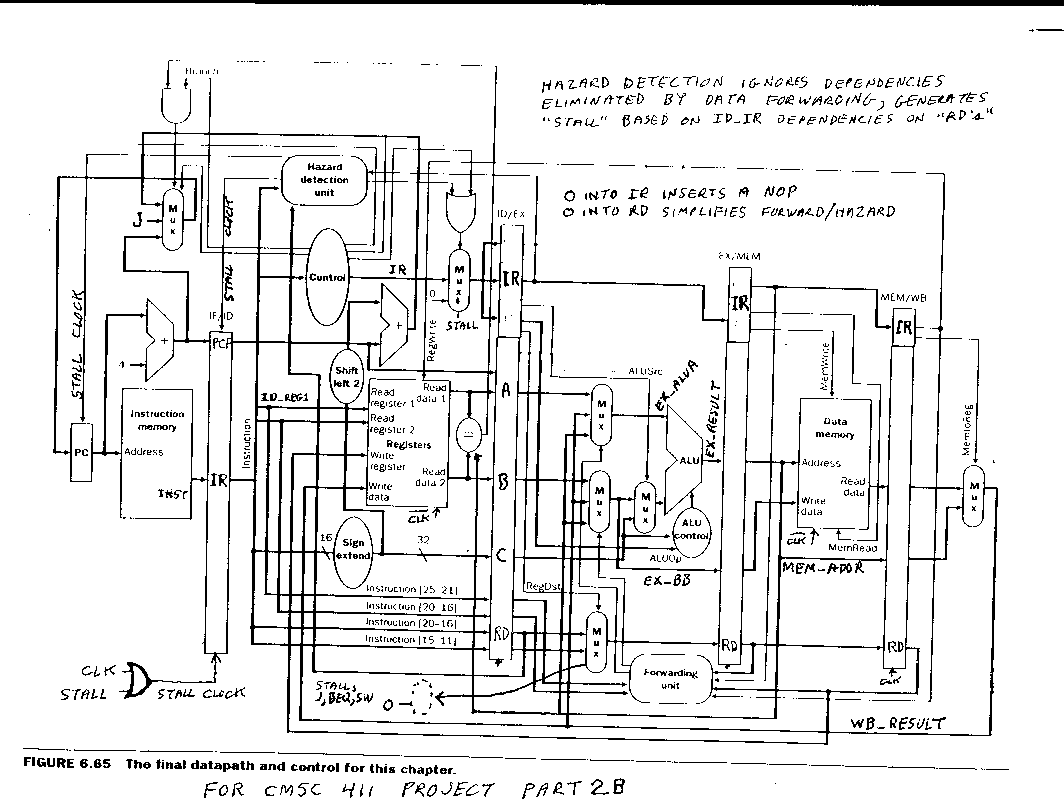
        The CS411 Project Part 2b uses a modified book Figure 6.65
        as shown in part2.gif
        or more specifically part2b.jpg

        Implement your circuit assuming that software has correctly
        filled the delayed branch slot and implement the branch in
        the ID stage as modified for this class project.

        For grading reasons, keep the signal names that
        are pipeline registers and the component/memory names.

        Download files part2a.abs and part2a.run and part2a.chk
        Run the following commands to check your work.

        ncvhdl -v93 add32.vhdl
        ncvhdl -v93 bshift.vhdl
        ncvhdl -v93 part2a.vhdl  # renamed and modified part1.vhdl
        ncelab -v93 part2a:schematic
	ncsim  -batch -logfile part2a.out -input part2a.run part2a

        diff part2a.out part2a.chk


        Download files part2b.abs and part2b.run and part2b.chk
        Run the following commands to check your work.

        ncvhdl -v93 add32.vhdl
        ncvhdl -v93 bshift.vhdl
        ncvhdl -v93 part2b.vhdl  # renamed and modified part2a.vhdl
        ncelab -v93 part2b:schematic
	ncsim  -batch -logfile part2b.out -input part2b.run part2b

        diff part2b.out part2b.chk

        Part2a  needs only data forwarding, jump and branch
                there is no need for stalls.

        Part2b  needs both data forwarding and hazards (stalls)
        Submit all components and your main circuit as one plain text
        file using 'submit'. No makefiles or run files or output is to be
        submitted. Partial credit will be given based on number of
        data forwards, jump, beq, and hazard stalls handled correctly.

        Your circuit will not be tested with jump or branch or data
        addresses greater than 10 bits, in other words your instruction
        and data memories do not need to be bigger than 1024 words.

        You may not get exactly the .chk results.
        Timing and stalls will be graded. Points will
        be deducted for memory or register differences
        or improper stalls.


 PART3: Copy part2b.vhdl to part3a.vhdl
        Substitute "part3a" for "part2b"
        Implement a cache in the instruction memory (read only)

        Copy part3a.vhdl to part3b.vhdl
        Substitute "part3b" for "part3a"
        Implement a cache in the data memory (read/write)

        Put the caches inside the instruction memory and
        and data memory components (entity and architecture).
        (you will need to pass a few extra signals in and out)

        Use the existing shared memory data as the main memory.
        Make a miss on the instruction cache cause a three cycle stall.
        Make a miss on the data cache cause a four cycle stall.
        Previous stalls from part2b must still work.

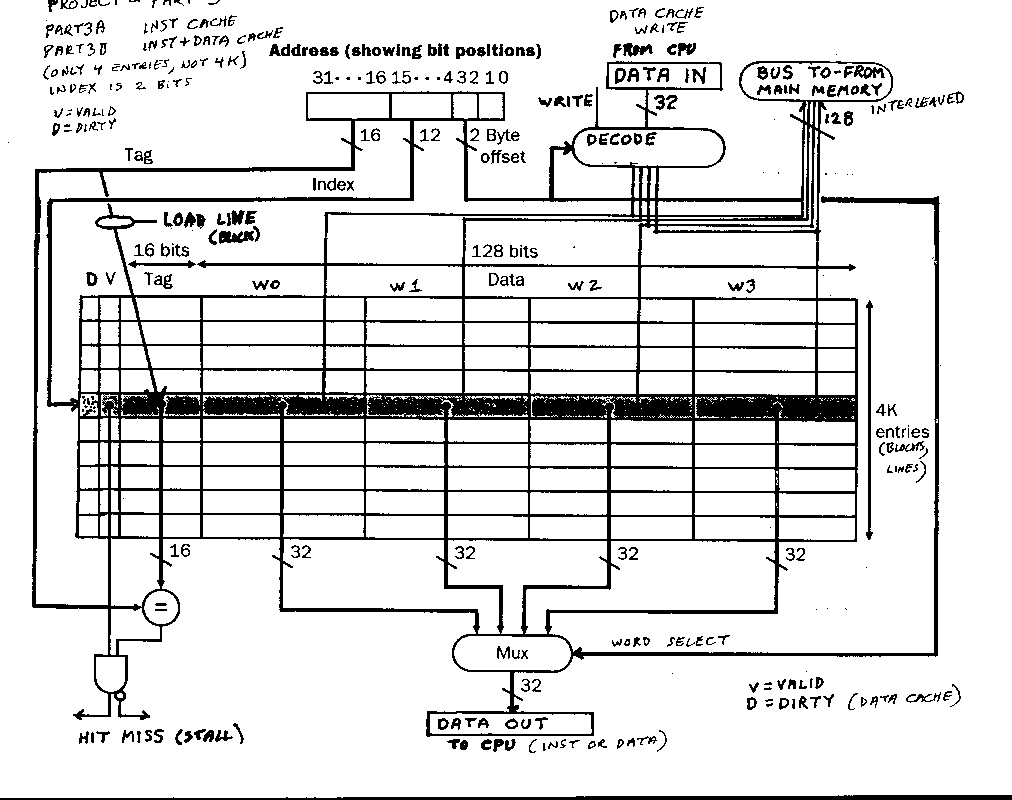
        Both instruction cache and data cache hold 16 words
        organized as four blocks of four words. Remember vhdl
        memory is addressed by word address, the MIPS/SGI memory
        is addressed by byte address and a cache is addressed by
        block number.

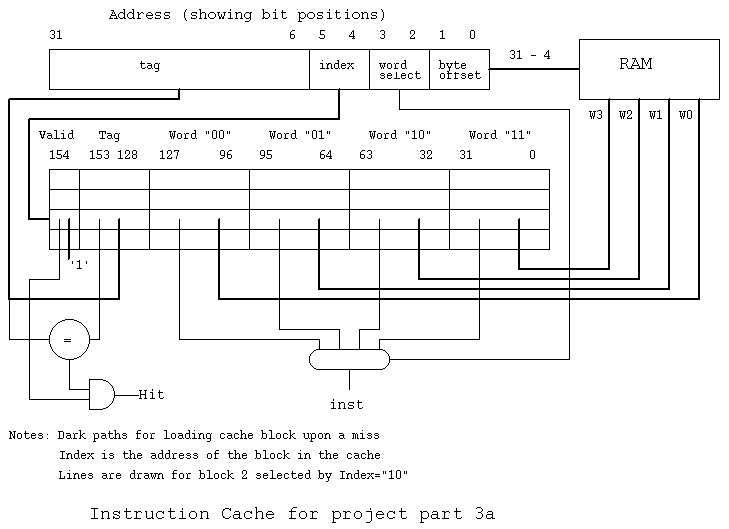
        Fig 7.10, page 557 is a possible read only cache for
        the instruction memory. Another view of the Icache is icache.jpg

        Possible, not required, VHDL to set up the start of a cache:
        (no partial credit for just putting this in your cache.)

          -- add in or out signals to entity instruction_memory as needed

          architecture behavior of instruction_memory is
            subtype block_type is std_logic_vector(154 downto 0);
            type cache_type is array (0 to 3) of block_type;
            signal cache : cache_type := (others=>(others=>'0'));
            -- now we have a cache memory initialized to zero
          begin  -- behavior
            inst_mem:
            process ... -- whatever, does not have to be 'addr'
              variable quad_word_addr : natural;  -- for memory fetch
              variable cblock : block_type;-- the shaded block in the cache
              variable index : natural;   -- index into cache to get a block
              variable word : natural;    -- select a word
              variable my_line : line;    -- for debug printout
              ...
            begin
              ...
              index := to_integer(addr(5 downto 4));
              word  := to_integer(addr(3 downto 2));
              cblock := cache(index);  -- has valid (154), tag (153 downto 128)
                                       -- W0 (127 downto 96), W1(95 downto 64)
                                       -- W2(63 downto 32), W3 (31 downto 0)
                                       -- cblock is the shaded block in Fig 7.10
              ...
              W0 := memory(quad_word_address);
                                       -- fill in cblock with new words, then
              cache(index) <= cblock after 30 ns; -- 3 clock delay
              miss <= '1', '0' after 30 ns;       -- miss is '1' for 30 ns
              ...

        For debugging you cache, you might find it convenient to add
        this 'debug' print process inside the instruction_memory architecture:


  debug:  process -- used to print contents of I cache
            variable my_line : LINE;   -- not part of working circuit
          begin
            wait for 9.5 ns;         -- just before rising clock
            for I in 0 to 3 loop
               write(my_line, string'("line="));
               write(my_line, I);
               write(my_line, string'("  V="));
               write(my_line, cache(I)(154));
               write(my_line, string'("  tag="));
               hwrite(my_line, cache(I)(151 downto 128));  -- ignore top bits
               write(my_line, string'("  w0="));
               hwrite(my_line, cache(I)(127 downto 96));
               write(my_line, string'("  w1="));
               hwrite(my_line, cache(I)(95 downto 64));
               write(my_line, string'("  w2="));
               hwrite(my_line, cache(I)(63 downto 32));
               write(my_line, string'("  w3="));
               hwrite(my_line, cache(I)(31 downto 0));
               writeline(output, my_line);
            end loop;
            wait for 0.5 ns;         -- rest of clock
          end process debug;


        You submit on GL using:  submit cs411 part3 part3a.vhdl

        Do a write through cache for the data memory.
        (It must work to the point that results in main memory are
         correct at the end of the run and the timing is correct,
         partial credit for partial functionality)
        You submit this as part3b.vhdl

        The CS411 Project Part 3 uses a modified book Figure 7.10
        as shown in part3.gif


        For grading reasons, keep the signal names that
        are pipeline registers and the component/memory names.

        Test first with only instruction cache.

        Download files part3a.abs and part3a.run and part3a.chk
        Run the following commands to check your work.

        ncvhdl -v93 add32.vhdl
        ncvhdl -v93 bshift.vhdl
        ncvhdl -v93 part3a.vhdl  # renamed and modified part2b.vhdl
        ncelab -v93 part3a:schematic
	ncsim  -batch -logfile part3a.out -input part3a.run part3a

        diff part3a.out part3a.chk

        Test with part3a.run and part3a.chk
        Submit instruction cache only as part3a.vhdl

        Test with both instruction and data cache.

        Download files part3b.abs and part3b.run and part3b.chk
        Run the following commands to check your work.

        ncvhdl -v93 add32.vhdl
        ncvhdl -v93 bshift.vhdl
        ncvhdl -v93 part3b.vhdl  # renamed and modified part3a.vhdl
        ncelab -v93 part3b:schematic
	ncsim  -batch -logfile part3b.out -input part3b.run part3b

        diff part3b.out part3b.chk

        Test with part3b.run and part3b.chk
        Submit instruction cache and data cache combined as part3b.vhdl

        Submit all components and your main circuit as one plain text
        file by using 'submit'. No makefiles or run files or output is to be
        submitted. Partial credit will be given based on number of
        instructions simulated correctly, number of hazards handled
        correctly and proper operation of Icache and Dcache.
Last updated 12/11/02