History of Programming Languages
Why study history?
- Something different
- Appreciation
- Inspiration
How to Look at History
- There are a few different ways programming language history is commonly explored
- Genealogically
- Attempts to derive more or less continuous lines of evolution from the earliest programming languages to today
- Innovations
- More concerned with major developments each language provided
- Genealogically
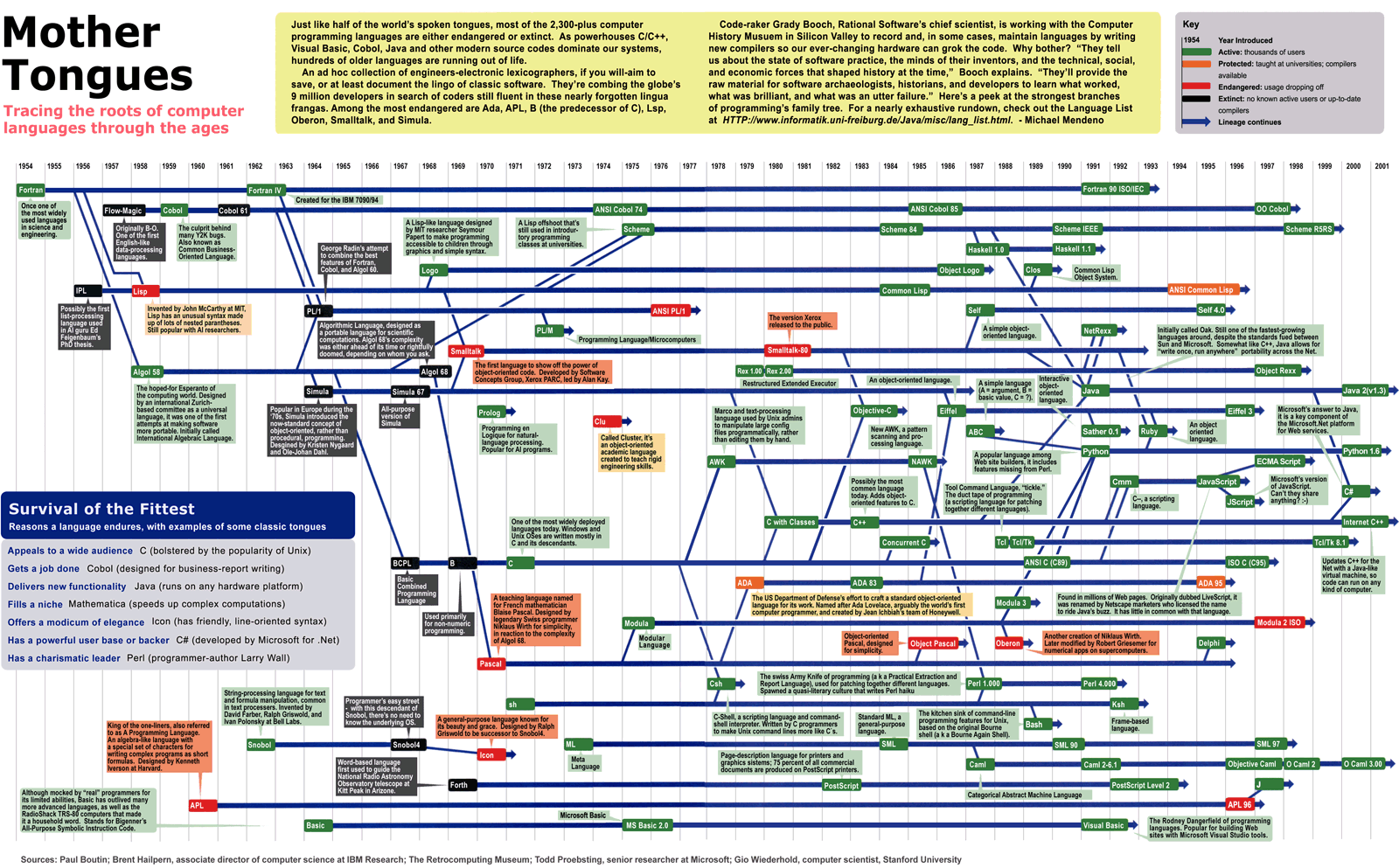 From
From Pre-Modern Era
- The ideas of automatic computation and programming are not recent
- In the 1800s
- The programmable loom of Joseph Jacquard
- Babbage's automatic difference engine
- Ada Lovelace - widely considered first programmer
The Dawn Of Computing
- The earliest computers were not programmable in our sense of the word
- Could not store programs
- Were often hardware based
Plankalkul
- From the German "program calculus"
- Invented around 1945, but not published until 1972
- Each statement was two or three lines of code
- Imagine writing fractions in ASCII only
- Also published were algorithms to sort arrays and other advanced problems
Shortcode
- One of the earliest programming languages
- Was interpreted to machine code
- Mathmatical expressions assigned numbers
- 06 - abs
- 2x - x + 2nd root
00 X0 03 20 06 Y0
The First Compilers
- Grace Hopper lead the team that built the first programs approximating compilers
- First produced in 1951, the A-0 compiler could comiple shortcode and other similar ecnoding schemes
- Produced machine code to be run directly on the hardware
- Followed by the A-1 and A-2 systems
- Ran on the UNIVAC architecture
Fortran
- FORmula TRANslation
- First version published in 1956
- One of the first high-level languages
- The most successful and influential certainly
- Developed to run on the IBM 704
- Had floating point and indexing capabilities!
- Still used for extremely fast mast applications to this day
Fortran Contributions
- Variables
- Expressions over numbers and booleans
- Fixed Length Arrays
- Reusable Subprograms (Functions)
- Input and Output Functionality
LISP
- Developed in the late 50s, specifically to support AI research
- Fotran had a list processing language that didn't support
- Recursion
- Conditional Expressions
- Dynamic Length Lists
- Garbage Collection
- LISP was highly influential, even if it was primarily limited to AI research labs in actual use
ALGOL
- An attempt to create and ALGOrithmic Language to run on any computer in the world
- Including Backus and Naur
- Designed by a commitee made up of representatives from
- German Society for Applied Mathmattics and Mechanics
- Association for Computing Machinery
- Design began in 1957
- Released in 1960
ALGOL 60 Contributions
- Blocks
- Type declarations
- Scope
- Nested If Statements
- Recursive Functions
- Dynamic Length Arrays
ALGOL's Legacy
- Conceptually is the basis for most modern languages
- Was never popular
- Hard to implement
- IBM didn't support it
- Put a damper on the general idea of design by committee
COBOL
- Still extremely widely used
- Banks, Government
- Meant for data processing
- Looks more "English"
- Design headed by the DoD
- First published in 1960
COBOL's Contributions
- File Descriptions
- Input and Output support in General
- Words rather than obscure functions
- Records
PL/I
- Released in the mid 60s
- Developed at IBM
- PL/I was meant to take what is best from Fortran, COBOL, and ALGOL
- First example of really trying to combine different programming language features
- Ended up being very complex
PL/I Contributions
- Exception Statements
- Pointers
- External Linking
BASIC
- Created as a teaching tool in the early 1960's
- Was still used in Montgomery County Public Schools in the early 2000s :)
- Later became popular as a basis for GUI programming
- Visual Basic
- First language designed to be run remotely, rather than as a tape or cards fed directly to the machine
Simula
- Designed in Norway for use in simulating a computer
- Simula I was released in 1964
- Simula 67 is the more influential version
- Based on ALGOL 60
- Supported co-routines
- As a by-product of this, had methods of data abstraction
The Precurors to C
- The UNIX operating system aws in early development in the late 1960s
- Common languages at Bell Labs at the time were BCPL, and an ever simpler version known as B
- Both were typeless
- Integer or Floating Point Division
- C was first released in 1972
- Borrowed a lot from ALGOL 68
The Popularity of C
- Didn't really introduce to many new features
- Was very flexible, and due to its use in the UNIX operating system, had a large audience
- Also meant there was a easy to get compiler for many different computers!
Smalltalk
- Smalltalk is considered the first object oriented language
- Was built out of a PhD Disseration from the University of Utah in 1969, by Alan Kay
- Developed at Xerox PARC
- First published in 1972
- Everything is an object
- All methods are called throug message passing
Smalltalk Contributions
- GUIS
- Orginally meant as a way to abstract an interface away from code
- Object Oriented Programming
- Inheritance
C++
- Developed at Bell Labs, just like the original C
- At first was just another version of C with better type checking
- C with Classes was first published in 1983
- C++ released in 1984
- Goals
- Fast, a superset on top of C
- Support classes and inheritance
The Impact of C++
- Although it borrowed from many other languages, it was many peoples first exposure to OOP
- Because it kept most of the sytnax of C, a lot of people had a good place to start
- Continues to be used very widely today
Java
- Started as a way to embed code into consumer devices by Sun Microsystems
- Originally a modified version of C++
- C++ was too dangerous in terms of what it allowed to be truly acceptable
- Should be more reliable
- Java doesn't allow functions outside of objects
Java Contributions
- First major language to not allow code to be compiled directly to machine code
- First major language to widely support multiple inheritance
- Its popularity spurred work on faster interpreters and VMs
- The JVM was very slow at first
After Java
- The history of programming languages becomes an unruely field after Java
- Part of the reason is we are still living in it
- The internet and GitHub make it much easier to write and publish a language to thousands of users
- The large supportive community around a language is often as much of a factor about its popularity as the features of the language itself
Scripting Languages
- In general, all modern scripting languages are based on features found in the original shell in Unix, know as
sh - Most modern languages are scripting languages
- This allows them to be written in a widely available lower language, like C
- The compiler/interpreter only has to be written once